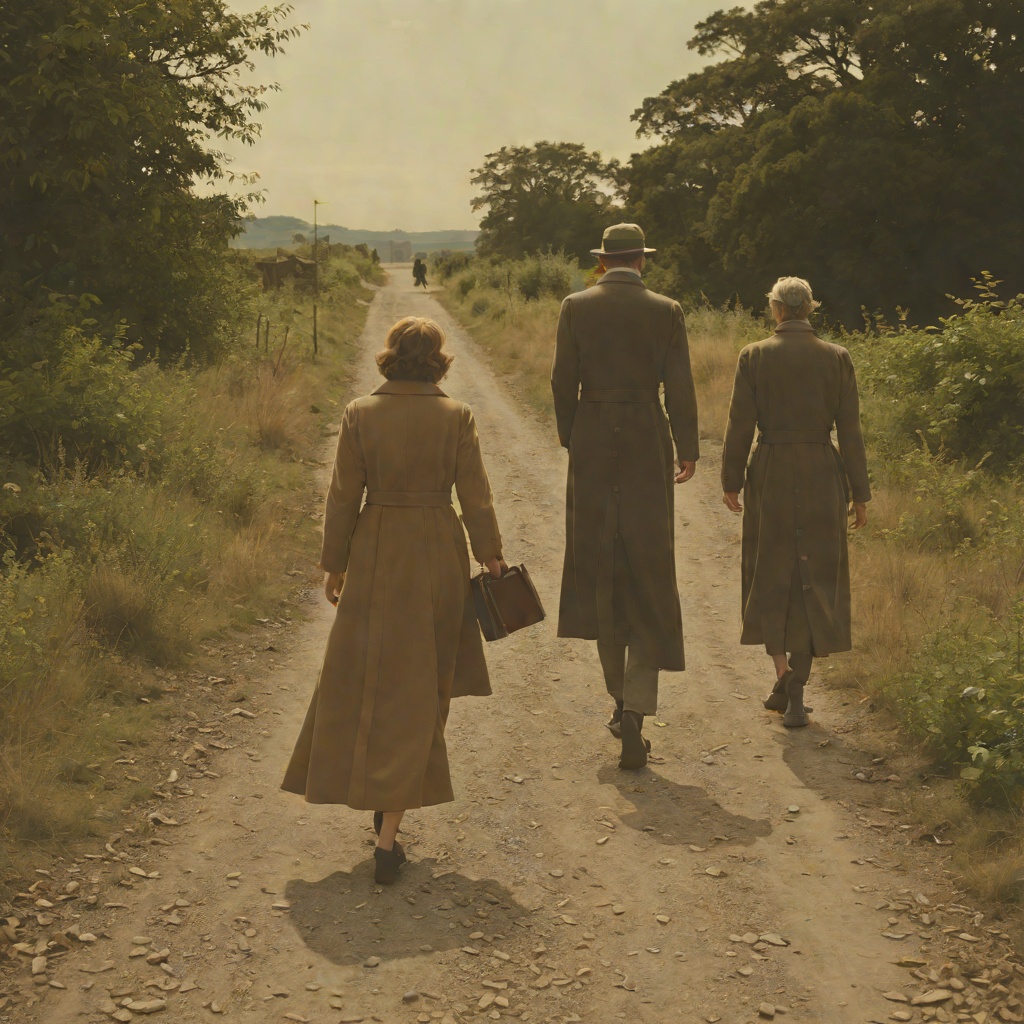
Harold's telephone call to Maureen from Loddiswell
The Unlikely Pilgrimage of Harold FryHarold's telephone call to Maureen from Loddiswell is the hinge on which the entire novel turns. It is the moment a quiet, unremarkable act of posting a letter becomes a public declaration of an impossible promise, and the moment Harold Fry's wife, Maureen, first learns that the man who never walks further than the car has resolved to walk the length of England. The call transforms a private impulse into a stated commitment, and in doing so it sets the pilgrimage in motion and exposes the deep fractures in a marriage that has been held together by silence for twenty years.
The Call from the Phone Box
Harold makes the call from a phone box just outside the pub at Loddiswell, on the B3196, almost five miles from the front door of 13 Fossebridge Road. He sounds pleased with himself, which is the first shock to Maureen. She had been rehearsing the worst possible outcomes — ambulances, policemen, holding Harold's inert hand — and instead finds him cheerful and full of news. He tells her he has had a lemonade but feels brilliant, better than he has felt in years, and that he met a nice chap who sells satellite dishes. Then he delivers what he clearly considers portentous news: he has made a promise to walk, all the way to Berwick. Maureen's disbelief is immediate and total. She asks if she has misheard, repeating the destination as if the words cannot possibly apply to him: "Walk? To Berwick-upon-Tweed? You?" Harold finds this very funny and splutters with laughter.
The Promise to Save Queenie
When Maureen asks him to be clear about what he is doing, Harold states his purpose with absolute certainty: he is going to walk, and Queenie is going to live. He is going to save her. Maureen's knees buckle and she throws her hand out to the wall to steady herself. Her response is brutal and practical: "I think not. You can't save people from cancer, Harold. Not unless you are a surgeon. And you can't even slice bread without making a mess. This is ridiculous." Harold, undeterred, explains that a girl at the garage gave him the idea — she saved her aunt from cancer because she believed she could — and even showed him how to heat a burger, complete with gherkins. Maureen is thrown by his certainty. She reminds him that he is sixty-five, that he only ever walks to get to the car, and that he has left his mobile phone behind. She asks where he thinks he is going to sleep. At this, the laughter stops and Harold's voice sounds stripped away. He admits he does not know, but insists that it is not enough to post a letter. "Please. I need to do this, Maureen."
Maureen's Fury and the Line Goes Dead
The way Harold appeals to her, adding her name at the end, childlike, as if the choice were hers when he has clearly already decided, ignites Maureen's spark of heat into a bolt of anger. She tells him to head off to Berwick if that is what he wants, and adds a cutting prediction: she would like to see him get past Dartmoor. The line is staccato'd with pips, and Maureen tightens her grip on the handset as if it were a piece of him she is clinging to. She asks if he is still in the pub; he replies that he is in a phone box outside, and that it is quite smelly, and then his voice cuts off. He is gone. Maureen gropes her body into the hall chair, and the silence is louder than if he had not phoned at all. The words Harold, Burger, Walk roll around her head, and in the midst of them come two more: Queenie Hennessy. After all these years, the memory of something long buried shivers deep inside her.
The Aftermath and the Weight of the Promise
The call leaves Maureen convinced at first that Harold will come back — that he will phone, cold and tired, and she will have to fetch him in the middle of the night, and it will all be his fault. She sleeps fitfully with the lamp on and the phone beside the bed, but he neither rings nor comes home. She replays the morning: the breakfast, the pink letter, Harold not speaking, only weeping in silence, and the way he folded his reply twice and slipped it in the envelope before she could see. She wants very much to speak to David, but she is afraid that if she does she will miss him, and it will be more hurt than she can bear. When Harold later calls again, she tells him only, "It has to be," and hangs up. Harold leaves the phone box wishing he could make her understand, but he knows that for years they have been in a place where language has no significance. She only has to look at him and she is wrenched to the past.
The Deeper Wound Beneath the Call
The call from Loddiswell is not merely the start of a journey; it is the surfacing of a buried history. The memory that shivers inside Maureen is of Queenie Hennessy coming to 13 Fossebridge Road twenty years ago, after David's suicide, looking very pale and carrying flowers, asking to give Harold a message about the brewery. Maureen put the flowers in the bin and never gave him the message. Harold, for his part, carries the weight of that same past: the son who hanged himself in the garden shed, the drinking that followed, the vandalism of the brewery for which Queenie took the blame and was fired. The call is the moment all of this unspoken grief and guilt begins to move. Harold's promise to walk is, in his own words, a way of saving Queenie, but it is also a way of doing something — anything — in the face of a loss that has defined his marriage and his life. As Maureen would later tell him, holding him after the grief passed, "You got up, and you did something. And if trying to find a way when you don't even know you can get there isn't a small miracle, then I don't know what is."